Guru Mantra with Meaning, Word-by-Word Translation, and Explanation
In Indian spirituality, the Guru — or spiritual master — is revered as the divine light that guides the seeker from ignorance to knowledge, darkness to light, and confusion to wisdom.
The sacred Guru Mantra —
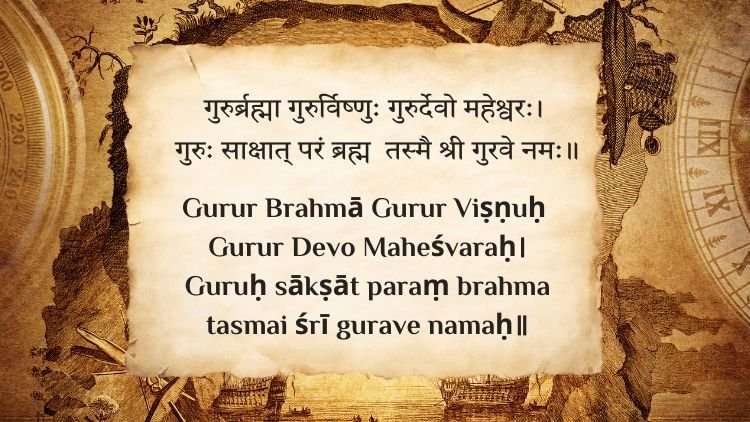
“Guru Brahma, Guru Vishnu, Guru Devo Maheshwara,
Guru Sakshat Parabrahma, Tasmai Shri Gurave Namah” —
is among the most powerful and widely recited invocations, offered as a heartfelt tribute to the Guru.
This mantra beautifully expresses the belief that the Guru embodies the Divine in all its aspects — Brahma, the Creator; Vishnu, the Preserver; and Maheshwara (Shiva), the Transformer. It reminds us that through the Guru’s grace, one perceives the ultimate reality — the Parabrahma, or supreme consciousness.
Text of the Guru Mantra
Devanagari Script:
गुरुर्ब्रह्मा गुरुर्विष्णुः गुरुर्देवो महेश्वरः ।
गुरुः साक्षात् परब्रह्म तस्मै श्रीगुरवे नमः ॥
Transliteration:
Guru Brahma, Guru Vishnu, Guru Devo Maheshwara,
Guru Sakshat Parabrahma, Tasmai Shri Gurave Namah.
Translation:
The Guru is Brahma — the Creator,
The Guru is Vishnu — the Preserver,
The Guru is Maheshwara (Shiva) — the Transformer.
The Guru is the very embodiment of the Supreme Reality, the Parabrahma.
To that divine teacher, I offer my humble salutations.
Line-by-Line Meaning and Explanation
Guru Brahma:
The Guru is compared to Brahma, the Creator, as it is through the Guru that knowledge and wisdom are first conceived in the heart of the disciple. The Guru gives birth to spiritual awakening and opens the mind to higher understanding.
Guru Vishnu:
The Guru embodies Vishnu, the Preserver, by nurturing the disciple’s growth through discipline, devotion, and moral guidance. Just as Vishnu sustains the universe, the Guru sustains the seeker’s journey on the spiritual path.
Guru Devo Maheshwara:
The Guru represents Shiva (Maheshwara), the Transformer, who destroys ignorance, ego, and illusion. Through the Guru’s teachings, the veil of darkness is lifted, revealing the light of truth and self-awareness.
Guru Sakshat Parabrahma:
The Guru is the living embodiment of the Supreme Reality — Parabrahma. Beyond all forms and identities, the Guru reflects the unmanifest, infinite truth that pervades all existence.
Tasmai Shri Gurave Namah:
With deep reverence, the disciple bows to the Guru, recognizing them as the divine channel of spiritual knowledge and enlightenment — the guiding force that leads from darkness to eternal light.
Spiritual and Philosophical Significance

The Guru Mantra beautifully represents the union of Divine consciousness and wisdom. By identifying the Guru with the creative, preservative, and transformative forces of the universe — symbolized by Brahma, Vishnu, and Shiva — the mantra conveys profound truths about the nature of learning and enlightenment.
-
Learning is sacred and spiritual, not merely intellectual or academic. The Guru serves as a vessel of divine knowledge, guiding seekers beyond the limitations of the mind.
-
Honoring the Guru is equivalent to honoring the path of truth, for it is through the Guru that one experiences the light of self-realization.
The very word “Guru” originates from Sanskrit:
-
Gu means darkness
-
Ru means remover
Thus, the Guru is the remover of darkness, the bringer of light, and the embodiment of the ultimate truth. The Guru Mantra encapsulates this sacred role — reminding every seeker that true wisdom dawns when one surrenders to divine guidance.
Advantages of Chanting the Guru Mantra
1. Cultivates Humility and Reverence:
Chanting the Guru Mantra nurtures deep respect and humility toward one’s Guru and the sacred lineage of teachers who illuminate the path of truth.
2. Enhances Learning and Self-Reflection:
The vibration of the mantra creates a calm, focused state of mind — ideal for learning, introspection, and spiritual growth. It sharpens concentration and brings mental clarity.
3. Dissolves Ego and Ignorance:
This sacred chant helps dissolve pride, ego, and arrogance, allowing wisdom to arise naturally from within. Through surrender, the seeker opens to true understanding.
4. Aligns with Divine Guidance:
The mantra keeps the practitioner attuned to the Guru’s blessings and universal energy, even when the Guru is not physically present. It strengthens the connection to divine protection and inner guidance.
5. Promotes Inner Peace and Stability:
Regular recitation brings deep tranquility, emotional balance, and a sense of divine harmony — easing tension, anxiety, and worldly worries.
Scientific Approach to Chanting Mantras
Modern science increasingly supports the therapeutic power of sound vibrations. When the Guru Mantra is chanted rhythmically, it creates subtle vibrations throughout the body. These vibrations calm the mind, balance emotions, and positively influence the nervous system — bridging the gap between ancient wisdom and modern science.
-
Neurological Benefits:
Repetitive chanting stimulates the vagus nerve, which helps regulate the parasympathetic nervous system. This process reduces stress, eases anxiety, and induces a state of deep relaxation. -
Emotional Harmony:
The resonance of the mantra fosters trust, surrender, and emotional balance. It quiets restless thoughts and enhances focus, bringing a sense of inner contentment and peace. -
Mind–Body Connection:
Scientific studies reveal that mantra chanting can lower blood pressure, slow the heart rate, and sharpen mental clarity. It harmonizes physiological and psychological functions, supporting overall well-being.
Thus, the Guru Mantra not only elevates spiritual awareness but also offers tangible physical and psychological benefits, reminding us that healing begins with vibration.
How and When to Chant
-
Morning Practice:
Begin your day by chanting the Guru Mantra before meditation, yoga, or study. Morning recitation helps align your mind and energy with clarity and devotion. -
Before Learning or Teaching:
Traditionally, the mantra is chanted before lessons or classes to invite wisdom, focus, and divine guidance into the learning process. -
On Guru Purnima and Special Occasions:
Chanting during Guru Purnima or on other auspicious days is a way of expressing gratitude and reverence to one’s spiritual master and lineage. -
With Mala Repetition:
For deeper concentration, repeat the mantra 108 times using a mala (rosary). The rhythmic repetition cultivates mindfulness and strengthens the spiritual connection.
Historical and Scriptural Context
The Guru Mantra originates from the Guru Gita — a sacred dialogue between Lord Shiva and Goddess Parvati found in the Skanda Purana. In this scripture, Lord Shiva reveals that the Guru is not separate from the Divine but is the manifestation of the Supreme Reality itself.
This philosophy echoes the teachings of the Upanishads, which emphasize that the Guru is the one who helps the disciple transcend ignorance and realize the Self.
In ancient gurukulas (ashrams), the daily recitation of this mantra sanctified the bond between teacher and student — transforming learning into a sacred act of devotion and awakening.
Conclusion
The Guru Mantra is far more than a simple hymn of devotion — it is a profound affirmation that the Guru embodies spiritual consciousness itself. Through its sincere chanting, seekers align with humility, wisdom, and the divine force that guides the soul toward liberation.
By honoring the Guru, one also honors the eternal cycle of creation, preservation, and transformation — the rhythm of life that sustains the universe. The mantra reminds us that the true Guru resides both within and without: as the inner voice of wisdom and as the external guide who awakens truth in us.
Ultimately, the Guru Mantra becomes both a personal meditation and a universal invocation, helping us recognize the divine presence in those who illuminate our path. When practiced daily, it serves as a sacred key to self-realization, inner peace, and timeless wisdom — virtues that continue to inspire seekers across generations.
FAQ
Q1. Can anyone recite the Guru Mantra?
Yes, absolutely. The Guru Mantra is universal and can be chanted by anyone who seeks spiritual guidance, wisdom, and reverence for knowledge.
Q2. Do I need a Guru to chant this mantra?
While having a Guru can deepen your understanding and spiritual experience, the mantra itself benefits all sincere seekers when chanted with faith, devotion, and consistency.
Q3. When is the best time to recite the Guru Mantra?
The most auspicious time is early morning (Brahma Muhurta) — a period of calm and high spiritual energy. However, it can also be recited before meditation, study, or any spiritual practice to invite clarity and focus.
Q4. Is the Guru Mantra only part of Hindu tradition?
Though its origins lie in Hindu scriptures, the essence of the mantra — honoring the teacher and source of wisdom — is universal and resonates across all spiritual paths and cultures.
Q5. How often should I chant the Guru Mantra?
Traditionally, it is repeated 108 times using a mala (rosary), symbolizing spiritual completion. Yet, even a few mindful and heartfelt repetitions can create a profound sense of peace and connection.
What's Your Reaction?