Om Purnamadah Purnamadam: The Mantra of Completeness
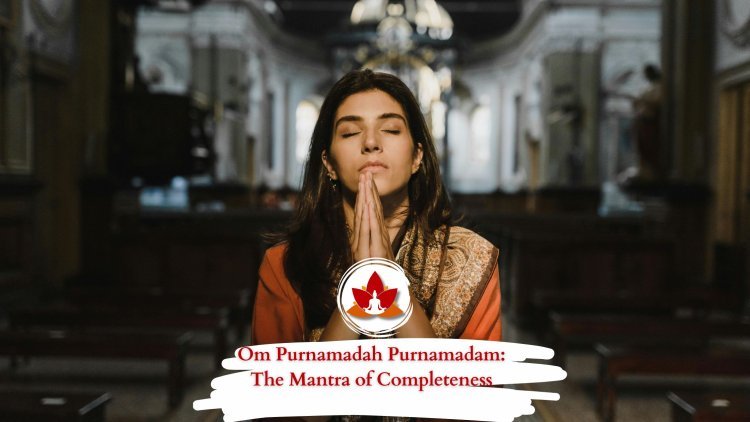
The Om Purnamadah Purnamadam is one of the most profound and timeless Shanti Mantras from the Upanishads, revered for its message of wholeness and divine completeness. More than just a chant, it is a sacred spiritual formula that reveals the eternal truth of creation, existence, and the Self.
This mantra teaches that everything in existence is already complete and perfect—nothing is missing, and nothing needs to be added. It reminds us that true peace arises from recognizing the fullness within ourselves and the universe.
In this article, you’ll explore the mantra’s meaning, translation, philosophical essence, spiritual significance, benefits of chanting, and its practical application in modern life. Through understanding and reflection, this sacred verse becomes a gentle guide toward inner harmony and self-realization.
The Text of the Mantra
Devanagari Script
“ॐ पूर्णमदः पूर्णमिदं पूर्णात् पूर्णमुदच्यते ।
पूर्णस्य पूर्णमादाय पूर्णमेवावशिष्यते ॥
ॐ शान्तिः शान्तिः शान्तिः ॥”
Transliteration
Om Purnamadah Purnamidam
Purnat Purnamudachyate
Purnasya Purnamadaya
Purnamevavashishyate
Word-by-Word Translation
-
Om: The primordial sound; the Absolute Reality
-
Adah: That (the ultimate, transcendent Reality)
-
Purnam: Whole, complete, perfect
-
Purnat: From that wholeness
-
Udachyate: Emerges, arises, or manifests
-
Adaya: Taking away, removing
-
Eva: Indeed, surely
-
Avashishyate: Remains, endures
Literal Meaning
"That is complete; this is complete. From the complete, the complete emerges. When the complete is taken from the complete, the complete still remains."
This verse reflects the eternal and unbroken nature of wholeness—showing that nothing is ever truly lost or diminished from the infinite.
Philosophical Significance
This mantra forms the foundation of Advaita Vedanta philosophy, expressing the profound idea that Absolute Reality (Brahman) is all-pervading and unchanging. The manifested world, though appearing separate, arises from that same completeness and thus is also complete in itself.
It beautifully illustrates the concept that infinity remains infinite, no matter what is taken from it. The mantra reminds us that our true essence is already whole and perfect, and that separation, lack, or incompleteness is merely an illusion of perception.
This teaching invites us to live with the awareness that we are not fragments seeking completion—we are expressions of the eternal whole itself.
Spiritual and Practical Implications

1. A Vision of Oneness
This mantra beautifully dissolves the illusion of duality. It teaches that the source and creation are one and the same. When we truly understand this, we begin to see every being as an extension of ourselves. Such a vision naturally gives rise to compassion, humility, and unconditional love, helping us live with greater harmony and empathy toward all.
2. An Attitude Toward Change
The mantra reminds us that while creation constantly evolves—being born, growing, and dissolving—the essence of wholeness remains unshaken. Understanding this truth helps us navigate life’s changes, losses, and uncertainties with greater resilience and inner peace. It encourages us to accept transformation as part of the eternal cycle, without losing touch with our infinite core.
Role in Vedic Tradition
Om Purnamadah Purnamadam is one of the Shanti Mantras, traditionally chanted before and after the study of the Upanishads. The recitation invokes peace, harmony, and readiness for higher learning, preparing both teacher and student to receive and share knowledge with clarity and serenity.
In Vedic rituals, the mantra is also used to sanctify the space and align participants with the cosmic rhythm of balance and unity. In yoga and meditation practices, it serves as a gentle reminder that we are not striving to become whole—we are simply awakening to the completeness that already exists within us.
Advantages of Chanting Om Purnamadah Purnamidam
1. Peacefulness of the Mind
The sacred vibration of this mantra gently calms and purifies the mind, dissolving distractions and leading the practitioner inward toward clarity and stillness. Regular chanting cultivates a deep sense of inner peace and focus.
2. Emotional Balance
By reminding us that we are already complete, the mantra helps soothe anxiety, fear, and insecurity. It restores emotional harmony and nurtures a sense of self-acceptance and inner contentment.
3. Spiritual Awakening
Chanting aligns the practitioner with the universal principle of oneness. It awakens higher awareness, deepens meditation, and connects one to the unchanging truth of existence.
4. Positive Aura
Like all Shanti Mantras, this chant radiates peaceful vibrations that harmonize the environment. It creates a serene energy field, bringing tranquility both within oneself and to those nearby.
Relevance in the Modern World
In a time dominated by competition, consumerism, and comparison, the message of Om Purnamadah Purnamidam is profoundly healing and revolutionary. It gently reminds us that:
-
We are not defined by possessions or social status.
-
Our worth remains intact, even through loss or failure.
-
Life’s ups and downs cannot diminish our inherent wholeness.
For spiritual seekers, this mantra is a light of wisdom. For everyday life, it is a gentle invitation to live with mindfulness, gratitude, and joy, rooted in the awareness that we are already whole.
Relevance to Other Traditions
The wisdom of Om Purnamadah Purnamidam transcends boundaries, finding reflections in various spiritual and philosophical traditions:
-
Buddhism: The concept of śūnyatā (emptiness) resonates with this mantra’s essence of wholeness and non-duality, showing that emptiness is not absence but infinite potential and completeness.
-
Christian Mysticism: The mantra’s vision of divine perfection and unity mirrors the Christian mystical experience of oneness with God and creation.
-
Modern Science: In physics, energy is neither created nor destroyed—only transformed. This aligns beautifully with the mantra’s assertion that wholeness is eternal and unbroken, no matter how forms may change.
Ideal Method of Chanting
To fully experience the depth of this mantra, it is best chanted during moments of serenity and receptivity:
-
Time: Early morning (Brahma Muhurta) or during evening meditation is ideal.
-
Posture: Sit comfortably with a straight spine, allowing energy to flow freely.
-
Breath: Maintain slow, steady, and mindful breathing.
-
Repetition: Traditionally recited 108 times using a mala, though even a few sincere repetitions can be deeply transformative.
-
Awareness: Focus not only on the sound but on the feeling of completeness and peace it awakens within.
Common Misconceptions and Truths
-
Myth: It is only for scholars or intellectuals.
Truth: Anyone seeking peace and inner clarity can chant this mantra. -
Myth: It is purely ritualistic.
Truth: The mantra transcends ritual—it embodies cosmic wisdom and spiritual truth. -
Myth: It brings material rewards.
Truth: Its power lies in awakening spiritual insight, inner harmony, and a profound sense of wholeness.
Om Purnamadah Purnamidam in Daily Life

This sacred mantra is not confined to temples or meditation halls—it offers timeless wisdom for everyday living:
-
In Relationships: It teaches us to love deeply yet without attachment, recognizing that every soul is complete in itself.
-
In the Workplace: It inspires ambition without greed, encouraging us to strive for excellence while remaining content and balanced.
-
In Adversity: It nurtures acceptance without despair, reminding us that even in loss, our inner wholeness remains untouched.
-
In Spiritual Practice: It dissolves the illusion of lack, guiding us to realize that we are already whole and divinely complete.
Conclusion
According to the Upanishadic tradition, Om Purnamadah Purnamidam is a sacred reminder that both the Absolute and the manifested world are complete and perfect. Nothing essential can ever be lost, for wholeness is our very nature.
Chanting this mantra awakens peace, strength, and clarity, helping us accept change with grace, live without fear, and see life as a seamless expression of the divine.
Ultimately, this mantra reveals a profound truth—wholeness cannot be diminished, divided, or destroyed.
True wisdom lies in realizing that the fullness of existence remains forever unbroken.
FAQs
Q1. Can anyone chant the mantra Om Purnamadah Purnamidam?
Yes, absolutely. This mantra is universal and open to everyone—there are no religious, cultural, or caste restrictions. It is a prayer for all who seek peace, wisdom, and inner balance.
Q2. What is the best time to chant this mantra?
Traditionally, it is best recited early in the morning or during evening meditation when the mind is calm and receptive. However, it can be chanted at any time of the day with sincerity and devotion.
Q3. Is this mantra only for spiritual seekers?
Not at all. While it holds deep spiritual meaning, its message of completeness and peace is universal. Anyone—regardless of their spiritual path—can benefit from its soothing and uplifting vibration.
Q4. How often should one chant it?
Traditionally, it is repeated 108 times using a mala. Yet, even a few mindful repetitions can bring tranquility and clarity. The power lies not in the number, but in the devotion and awareness with which it is chanted.
What's Your Reaction?