Nirvana Shatakam by Adi Shankaracharya: Significance and Meaning
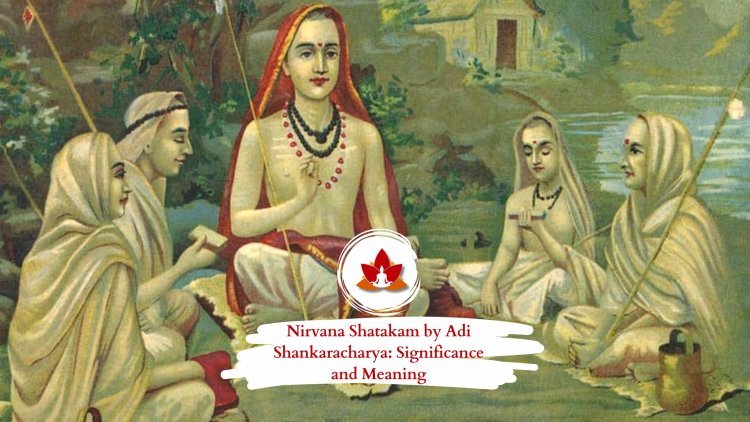
The Nirvana Shatakam (also known as Atma Shatakam) is one of the most profound spiritual compositions attributed to Adi Shankaracharya, the 8th-century sage, philosopher, and proponent of Advaita Vedanta—the philosophy of non-duality.
Comprising six transformative verses, this timeless hymn serves as a declaration of the ultimate realization: the understanding that the Self (Atman) is beyond body, mind, and emotions—one with the infinite Consciousness (Brahman). More than poetry, it is a direct revelation of truth—a guide to self-realization and liberation (moksha).
Historical Background
According to tradition, Adi Shankaracharya composed these verses when his Guru asked him a simple yet profound question:
“Who are you?”
In response, the young seeker uttered these six verses that revealed his awakened understanding of the Self. Since then, this sacred hymn has been known as the Nirvana Shatakam—the Six Verses of Liberation.
Each stanza reflects the method of self-inquiry central to Vedanta—renouncing all that is not the Self to uncover the eternal truth of what one truly is. Through this process of negation (neti neti—“not this, not this”), the hymn illuminates the nature of the Self as:
eternal, pure consciousness—unbound, timeless, spaceless, and causeless.
Nirvana Shatakam by Adi Shankaracharya – Text and Meaning
The Nirvana Shatakam, composed by Adi Shankaracharya, is a poetic expression of the ultimate spiritual truth—realizing one’s identity as pure consciousness, beyond all limitations.
Each verse dismantles the layers of ego and illusion, revealing the Self as eternal bliss (Ananda) and awareness (Chaitanya).
Verse 1
Mano buddhyahankara chittani nāham
Na cha shrotra jihve na cha ghrāṇa netre
Na cha vyoma bhūmir na tejo na vāyuh
Chidānanda rūpah shivoham shivoham
Meaning:
I am not the mind, intellect, ego, or memory.
I am not the senses of hearing, taste, smell, sight, or touch.
I am not the five elements—space, earth, fire, air, or water.
I am the embodiment of pure bliss and consciousness.
I am Shiva. I am Shiva.
???? This verse begins the journey of self-realization, guiding us to detach from everything we falsely identify as “I.”
Verse 2
Na cha prāṇa sangno na vai pancha vāyuh
Na vā sapta dhātur na vā pancha kośah
Na vāk pāṇi pādam na chopastha pāyu
Chidānanda rūpah shivoham shivoham
Meaning:
I am not the life force (prana) nor the five vital airs.
I am not the seven bodily substances, nor the five sheaths of existence.
I am not the organs of speech, action, reproduction, or elimination.
I am pure blissful consciousness.
I am Shiva. I am Shiva.
Here, Shankaracharya takes the seeker deeper—disassociating from the physical and subtle bodies to realize the infinite Self.
Verse 3
Na me dvesha rāgau na me lobha mohau
Na me vai mado naiva mātsarya bhāvah
Na dharmo na chārtho na kāmo na mokshah
Chidānanda rūpah shivoham shivoham
Meaning:
I have no hatred or attachment, no greed or delusion.
I am untouched by pride and jealousy.
I transcend the pursuits of duty, wealth, pleasure, and even liberation.
I am pure consciousness and bliss.
I am Shiva. I am Shiva.
This verse liberates the seeker from emotional dualities and worldly desires, unveiling the serene freedom of the Self.
Verse 4
Na punyam na pāpam na saukhyam na duhkham
Na mantro na tīrtham na vedā na yajñah
Aham bhojanam naiva bhojyam na bhoktā
Chidānanda rūpah shivoham shivoham
Meaning:
I am neither virtue nor sin, neither pleasure nor pain.
I am not sacred chants, pilgrimages, scriptures, or rituals.
I am neither the object, the experience, nor the experiencer.
I am bliss and pure awareness.
I am Shiva. I am Shiva.
The seeker realizes that liberation lies not in external acts of worship, but in the recognition of the inner Self.
Verse 5
Na me mrityu shankā na me jāti bhedah
Pitā naiva me naiva mātā na janmah
Na bandhur na mitram gurur naiva shishyah
Chidānanda rūpah shivoham shivoham
Meaning:
I have no fear of death, nor do I belong to any caste or creed.
I have no father or mother, no birth or lineage.
I am beyond all relations—friend, teacher, or disciple.
I am blissful awareness itself.
I am Shiva. I am Shiva.
This verse dissolves all boundaries of identity and relationship, revealing the Self as universal and eternal.
Verse 6
Aham nirvikalpo nirākāra rūpo
Vibhutvā cha sarvatra sarvendriyānām
Na cha sangatham naiva muktir na meyah
Chidānanda rūpah shivoham shivoham
Meaning:
I am beyond all thought and form.
I am omnipresent, pervading all senses and existence.
I am neither bound nor liberated, for I am ever free.
I am pure bliss and awareness.
I am Shiva. I am Shiva.
In the final verse, the seeker becomes the realized one—recognizing the Self as infinite, formless, and one with all.
Philosophical and Spiritual Implications

The Nirvana Shatakam serves as a profound spiritual exercise in Atma Vichara—the inquiry into the true nature of the Self. Through the method of negation (Neti Neti – “not this, not this”), Adi Shankaracharya leads the seeker beyond all false identities to realize the essence of the Self.
1. The Process of Neti (Not This)
Each verse is a meditative denial of what we are not—body, mind, senses, emotions, or even roles shaped by society and religion.
By systematically rejecting all transient identities, the seeker peels away layers of illusion (Maya), revealing the truth that lies beneath—the eternal Self.
2. The True Self Affirmation
When all that is unreal is removed, what remains is the unchanging essence of being.
The repeated refrain—“Chidananda Rupah Shivoham Shivoham”—is not merely a chant, but an awakening.
It affirms: I am Pure Consciousness and Bliss. I am Shiva.
This is the realization that the Self (Atman) and the Supreme (Brahman) are one and the same—undivided, infinite, and eternal.
3. The Freedom of Self-Realization
Such knowledge dissolves the roots of fear, sorrow, and ignorance.
When the illusion of separateness fades, what emerges is the state of Nirvana—complete liberation and peace.
It is not an escape from life, but a transcendence of duality—where joy and sorrow, life and death, all merge into one infinite stillness.
Symbolism and Practice of Meditation
The continuous repetition of the mantra “Shivoham” (I am Shiva) becomes a powerful meditation in itself.
It aligns the individual consciousness (Jivatma) with the cosmic consciousness (Paramatma), gently dissolving the illusion of individuality.
Each repetition serves as a sacred reminder that:
-
The Self is eternal, beyond birth and death.
-
The true nature of existence is blissful and luminous.
-
The divine is not outside us—it is who we are.
Meditating on “Shivoham” thus becomes a living experience of oneness—a merging of the wave into the ocean of consciousness.
Benefits of Reciting the Nirvana Shatakam
The Nirvana Shatakam is more than a chant—it is a sacred mirror that reflects the truth of who we really are. Regular recitation brings inner transformation, helping the seeker move from illusion to liberation.
1. Inner Detachment
Chanting the verses cultivates deep detachment from the ego, body, and worldly attachments. It reminds us that we are not the roles we play but the awareness behind them.
2. Clarity of Mind
The hymn sharpens self-awareness and dissolves confusion. With clarity comes inner strength, courage, and the ability to face life with equanimity.
3. Spiritual Awakening
The verses awaken the dormant understanding of Advaita Vedanta—the philosophy of oneness. Through practice, one begins to experience unity rather than merely believe in it.
4. Peace and Stillness
Regular chanting soothes the nervous system and calms the restless mind. Fear and anxiety fade as one realizes the Self is untouched by external circumstances.
5. Sense of Universal Self
The hymn transcends religion, caste, and identity. It reminds us that the divine essence within all beings is one—unlimited and eternal.
Relevance in Today’s World
In an age defined by material pursuits, stress, and emotional chaos, the Nirvana Shatakam offers timeless wisdom. It gently reminds us that true happiness lies within, not in possessions or achievements.
-
You are greater than your job or your status.
-
Your thoughts do not define your true Self.
-
Real bliss arises from awareness of your infinite nature, not from external success.
With this understanding, one develops resilience, compassion, and clarity of purpose.
The Nirvana Shatakam thus remains an evergreen guide—a spiritual compass for modern life, leading us back to peace, balance, and self-realization.

Conclusion
The Nirvana Shatakam is not merely a set of six verses—it is a revelation of the ultimate truth of existence.
It reminds us that moksha (liberation) is not a distant goal but a realization of our own eternal and unchanging Self.
Composed by Adi Shankaracharya, this timeless hymn continues to illuminate the path for seekers across the world. It teaches that our true nature is beyond fear, beyond death, and beyond illusion.
By reading, chanting, or meditating upon these verses regularly, one can experience profound inner peace, mental clarity, and spiritual freedom. Each recitation draws the seeker closer to the truth—“Chidananda Rupah Shivoham Shivoham”—I am bliss and pure consciousness.
Frequently Asked Questions
What's Your Reaction?